

Asia Pacific University
(Nurturing Professionals)
MINI GALLERY



- RANK
- INTAKE
- COURSES
- FEES
- SCHOLARSHIPS
- FACTS
- STUDENT LIFE
- LOCATION
APU is ranked joint 528th in the QS World University Rankings 2027, its best result so far, up from 597th the year before and within the top 2% of universities worldwide. Within that ranking, APU is 20th in the world for international students, one of the measures QS uses to score how international a university is.
In Asia, APU placed in the top 150 in the QS World University Rankings: Asia 2026 and in the top 40 in Southeast Asia. It also holds an overall “5 Stars Plus” rating from QS, an audit that rates universities on teaching, employability, facilities and inclusiveness.
Asia Pacific University (APU) has more intakes than most Malaysian universities. For 2027, the main entry points are:
- Foundation programme: February, April, July, August and November.
- Diploma programmes: April, July, August and November, depending on the programme.
- First year of a bachelor’s degree: March, July, September and November.
- Master’s degrees: February, June and September, with rolling intakes for some programmes.
- PhD and DBA: monthly intakes throughout the year.
Programme variations
- Engineering degrees: four-year honours programmes, with the same degree intakes as other bachelor’s courses.
- International merit awards: limited and given in order of application, so applying early matters as much as the intake date.
International students should apply early enough to receive the offer and the student visa approval letter from Education Malaysia Global Services before the start date. See APU’s courses for programme details.
APU teaches foundation, diploma, bachelor’s, master’s and doctoral programmes. Students with A-Levels, the IB or an equivalent enter the first year of a degree directly, while others start with the APU Foundation Programme or a two-year diploma. The main undergraduate programmes are:
- Computing, technology and games development
- Bachelor of Science (Honours) in Computer Science, with specialisms in Data Analytics and Digital Forensics
- Bachelor of Science (Honours) in Computer Science (Cyber Security)
- Bachelor of Computer Science (Hons) (Intelligent Systems)
- Bachelor of Science (Hons) in Software Engineering
- Bachelor of Science (Honours) in Information Technology, with specialisms in Information System Security, Cloud Engineering, Internet of Things (IoT), Digital Transformation, Financial Technology (FinTech), Business Information Systems and Sustainable Computing
- Bachelor of Science (Hons) in Multimedia Technology
- Bachelor of Science (Honours) in Computer Games Development
- Accounting, banking, finance and actuarial
- BA (Hons) in Accounting and Finance, with specialisms in Forensic Accounting, Forex and Investments, and Accounting Technology
- Bachelor in Banking and Finance (Hons), with specialisms in Investment Analytics and Financial Technology
- Bachelor of Science (Honours) in Actuarial Studies
- Business, management, marketing and tourism
- Bachelor of Arts (Honours) in Business Management, with specialisms in E-Business, Digital Leadership and Business Analytics
- BA (Hons) Human Resource Management
- Bachelor of Arts (Honours) in International Business Management
- Bachelor of Arts (Honours) in Marketing Management, including Digital Marketing
- Bachelor of Arts (Honours) in Tourism Management, including Hospitality
- Engineering
- Bachelor of Electrical and Electronic Engineering with Honours
- Bachelor of Engineering in Mechatronic Engineering with Honours
- Bachelor of Mechanical Engineering with Honours
- Bachelor of Computer Engineering with Honours
- Bachelor of Petroleum Engineering with Honours
- Media, international relations and psychology
- Bachelor of Arts (Honours) in Media and Communication Studies
- Bachelor of Arts (Honours) in International Relations
- Bachelor of Science (Honours) in Psychology
- Design, advertising and animation
- Bachelor of Arts (Honours) in Industrial Design
- Bachelor of Arts (Honours) in Visual Effects
- Bachelor of Arts (Honours) in Animation
- Bachelor of Arts (Honours) in Digital Advertising
- Foundation and pathway programmes
- APU Foundation Programme, with business, computing, engineering, and architecture and design routes
- Two-year diploma programmes, leading directly into the second year of a degree
Many APU degrees can be taken as a dual award with De Montfort University in the UK.
For the full list, see all APU programmes and pathways.
APU does not publish a current international fee guide online. Students should check the official programme pages or ask APU’s admissions team for the fees that apply to their programme and intake. APU’s fees for international students exclude the 6% service tax, which is added on top.
For current fees, see APU’s official programme pages.
APU’s international merit awards for 2026 to 2027 take 10% to 30% off tuition for new international students, based on final school results:
- A-Levels: 30% for AAA, 20% for AAB, and 10% for ABB or AAC.
- IB Diploma: 30% for 34 points and above, 20% for 30 to 33 points, and 10% for 26 to 29 points.
- O-Levels or IGCSE: 30% for 8 to 9 As, 20% for 6 to 7 As, and 10% for 4 to 5 As.
- IB Middle Years Programme: 30% for 48 points and above, 20% for 44 to 47 points, and 10% for 35 to 43 points.
The awards apply to tuition fees only and are given on a first-come, first-served basis, so students with strong results should apply as early as possible. For the full list, see APU’s international scholarships and merit awards.
APU was established in 1993 and now has more than 13,000 students from over 130 countries, making it one of the most international campuses in Malaysia. Its graduates recorded 100% graduate employability in the Malaysian Ministry of Higher Education’s latest Graduate Tracer Study.
APU has been recognised by the Malaysia Digital Economy Corporation as a Premier Digital Tech University, and in 2024 it became the first Malaysian university to gain accreditation from the UK’s Quality Assurance Agency (QAA). Students from Kuwait, Qatar, Oman and the UAE should confirm that their ministry of higher education recognises the specific programme before enrolling, as each ministry keeps its own approved list.
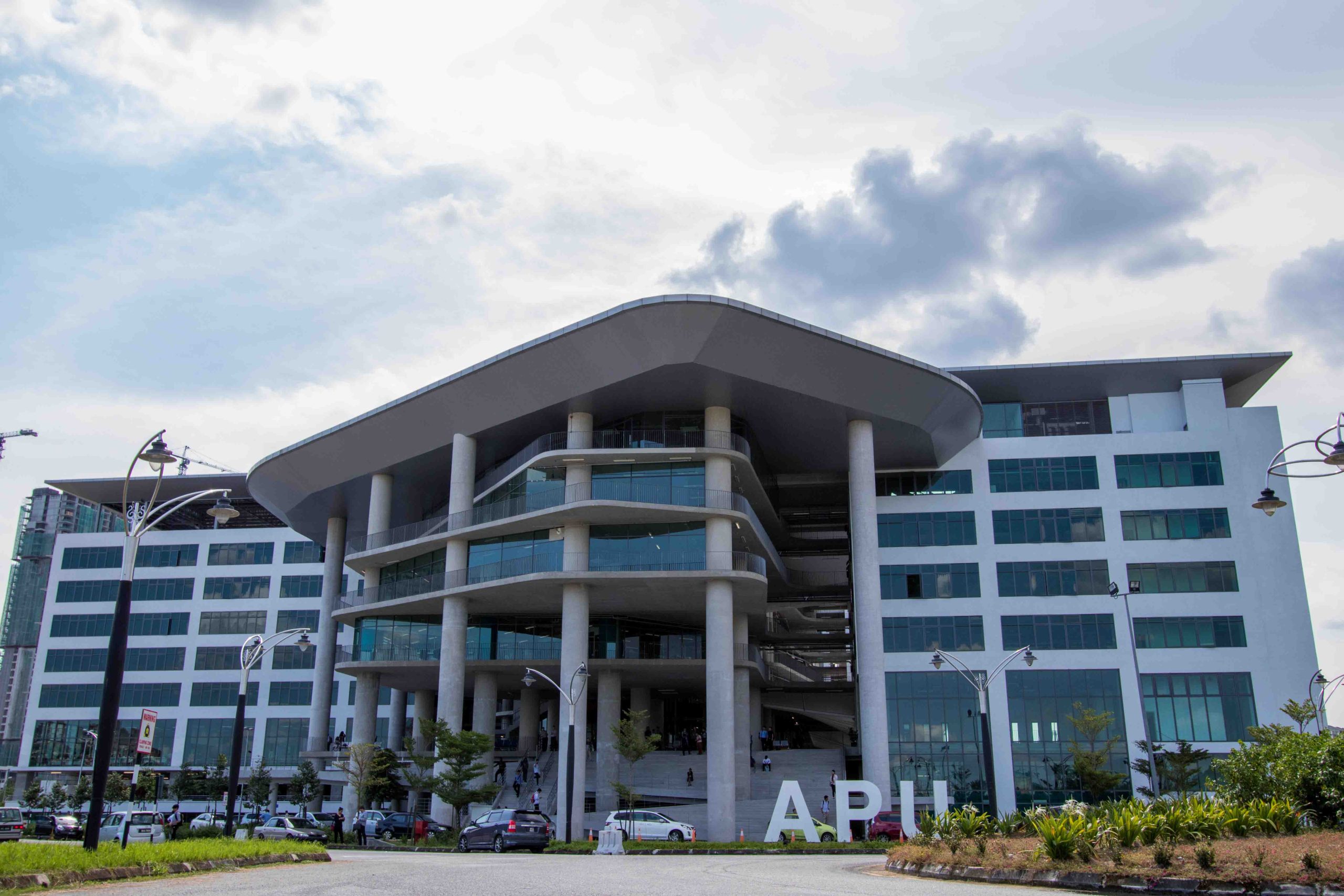
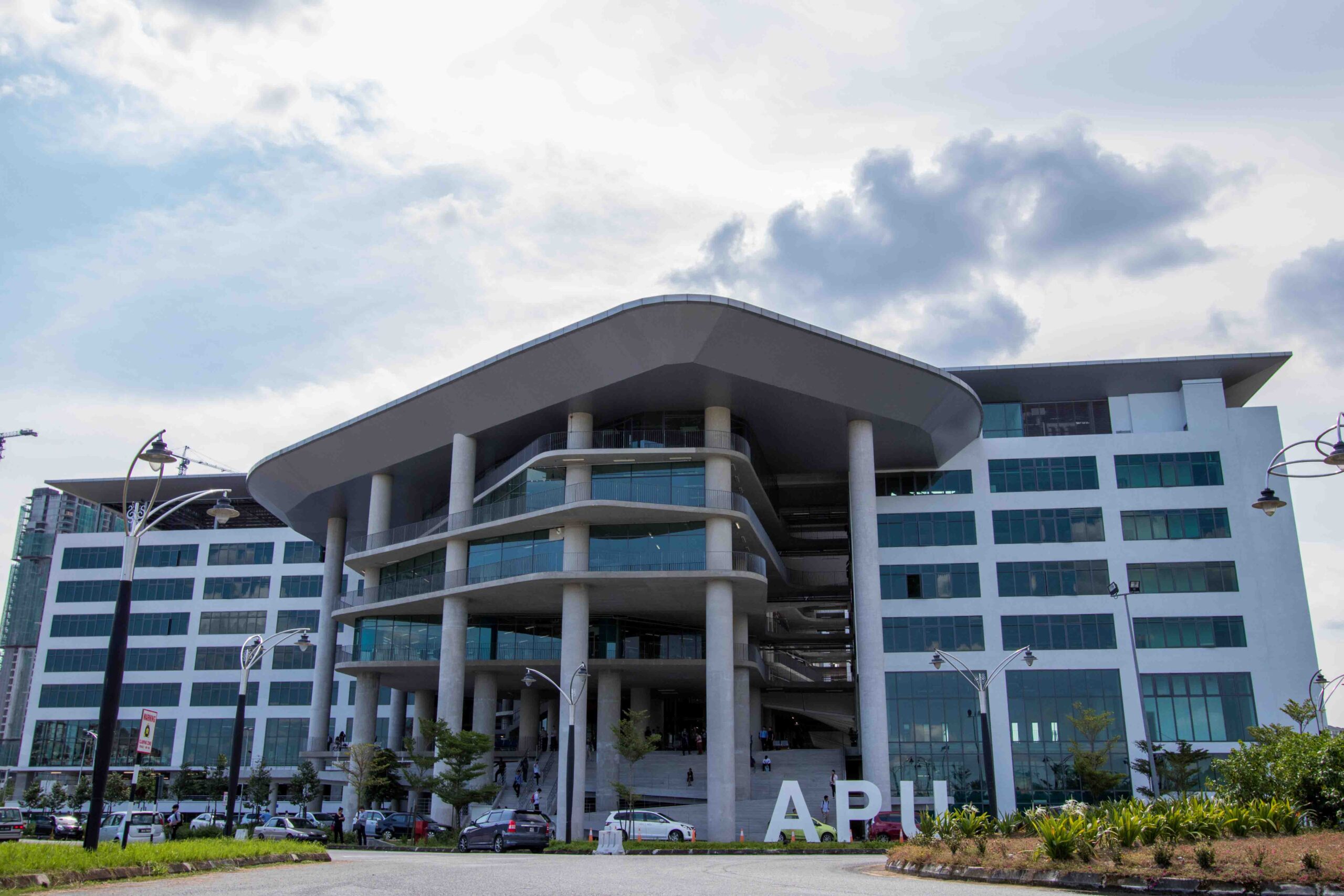
APU’s campus at Technology Park Malaysia is purpose-built, with lecture halls, labs, a library, sports facilities and a swimming pool, and students mix with classmates from more than 130 countries through clubs, societies and cultural events. Shuttle buses run between the campus and the Bukit Jalil LRT station.
The APU Residence is on campus, with en-suite single rooms from RM1,300 a month and en-suite twin rooms from RM990 a month per person, and larger single rooms costing up to RM1,760 a month. Each room type also carries a one-off charge of RM400, and residents pay two months’ deposit and one month’s rent when they check in. APU’s accommodation team also helps students find rooms in nearby condominiums.
APU is at Technology Park Malaysia, Bukit Jalil, 57000 Kuala Lumpur, in the south of the city, beside the Kuala Lumpur-Seremban Highway. The nearest rail link is the Bukit Jalil LRT station, served by APU’s shuttle buses, and Kuala Lumpur International Airport is reachable by road or by rail from the city.


Asia Pacific University is one of EMGA’s partner universities, so students can apply to APU through EMGA instead of applying on their own. EMGA helps students from Kuwait, Qatar, Oman, Saudi Arabia and the UAE through every step, from picking a programme and checking entry requirements to the offer letter and student visa. Counsellors prepare and submit the APU application, follow up on the offer, and guide students through the student visa process with Education Malaysia Global Services. The service is free, and counsellors track each intake deadline so applications go in on time.
Talk to an EMGA counsellor about studying at APU.